A contractor asked me last month whether he should just build the site himself. Fair question. The tools are genuinely good now. You drag blocks around, pick a template, type your hours, and something respectable is live by dinner. For a lot of businesses that is the correct move, and I am not going to pretend otherwise. This is not a pitch that says DIY is a trap. It is the actual math, laid out, so you can tell which side of the line your business sits on.
Where a DIY builder is the right answer
There are real cases where you should skip everything below and go build it yourself. A drag-and-drop builder is hard to beat when the situation looks like one of these:
- You are testing an idea and do not yet know if the business sticks
- The website is a formality: nobody uses it to find you or choose you
- You actually enjoy the tinkering, and a Saturday nudging fonts is a Saturday you wanted anyway
- The stakes are low: a food truck with a loyal following, a club that meets on Thursdays, a solo artist selling a few prints
If that describes you, keep your money and build it yourself. We say this on the phone all the time. A builder runs ten to forty dollars a month, no contract, and you control every word. For a clean page that states the facts, it is a fine tool and there is no shame in using it.
The cost DIY hides: your nights and weekends
The sticker price on a builder is honest. The real cost is not on the sticker. It is the twenty hours you spend learning the editor, the Sunday you lose figuring out why the contact-form emails land in spam, and the photo shoot you keep meaning to schedule. Your time has a rate. If you bill a hundred an hour on the tools, a twenty-hour build cost you two thousand dollars in jobs you did not run, before the site made a single phone ring.
Then it goes stale. The DIY site launches looking sharp, and eight months later the hours are wrong, the summer promo is still up in November, and the footer says 2024. Not because you are lazy. Because the site is the ninth thing on a list of eight, and it keeps working well enough that nobody notices the rot. A stale site quietly tells a customer you might be out of business.
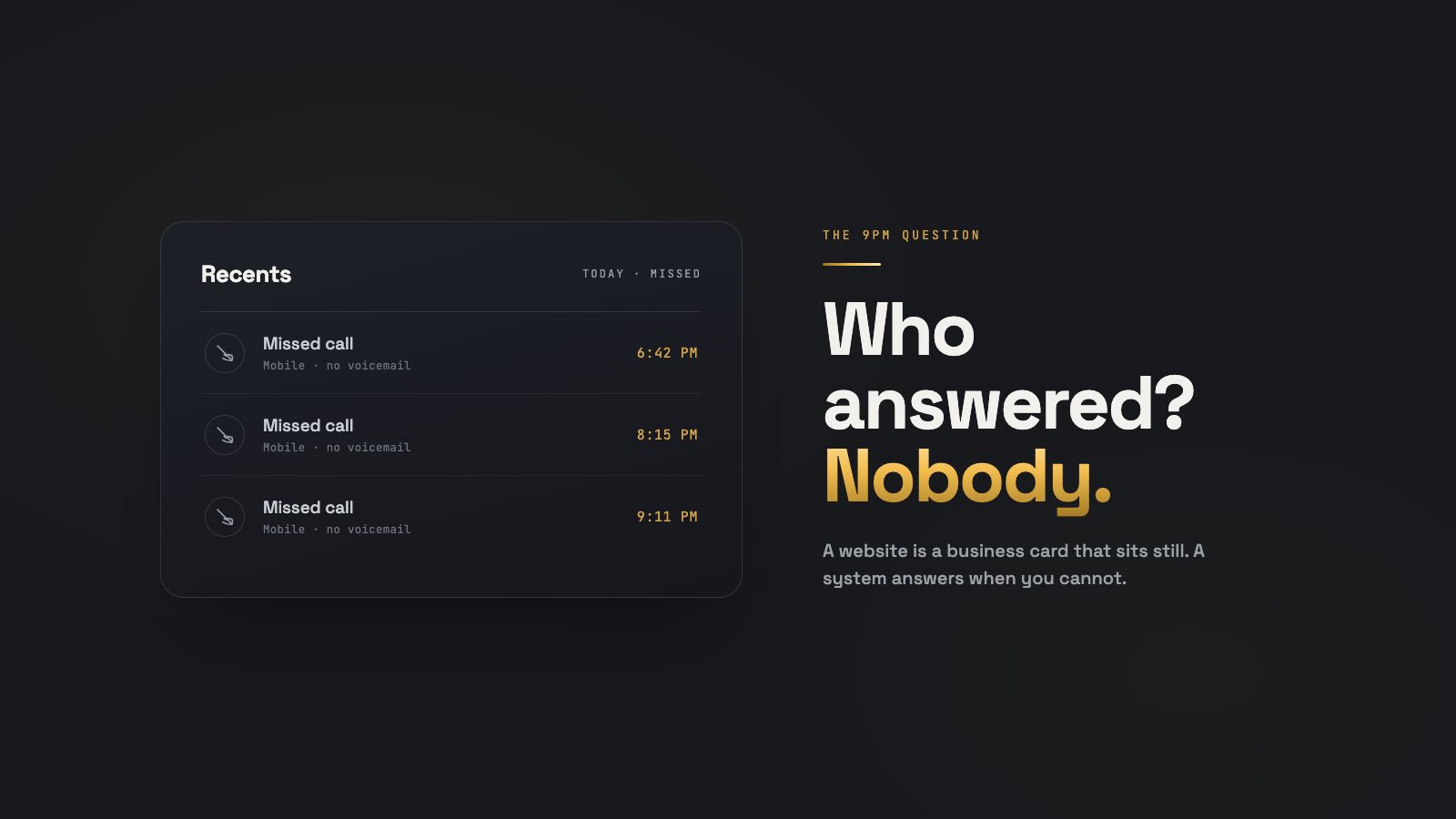
The bigger gap is what happens after someone lands on it. A builder gives you a page. It does not give you anything that catches the lead while you are on a roof or asleep. The form just sits there. Somebody fills it out at 9pm, the email drops into an inbox you open at 7am, and by then they have already called two other numbers. The page was never the weak part. The follow-up was.
The whole comparison in one line: a website is a business card that sits still. A system answers when you cannot.
The middle path: hire a local agency
One step up from DIY is the custom agency build. Quotes for a real business site commonly land in the three to eight thousand dollar range, and for that you get design, a handful of pages, and a team that knows what it is doing. When it fits, it fits well. If you have a real budget, a specific brand, and a project big enough to justify the meetings, a good agency earns the check.
The catch is the handoff. You pay the invoice, the site goes live, and then you own the problem. Hosting gets billed separately. Updates get billed separately, or folded into a care plan that starts around a hundred to three hundred a month on top of the build. And most of these still hand you a page, not a lead system. You can spend five thousand dollars and the 9pm question is still sitting there unanswered.
What we do differently
We are LegacyForge AI, based in Sioux Falls. We build for businesses anywhere: the web work happens over a link, so the map does not matter. We build the entire site first, send you a live URL, and let you judge the finished thing before a dollar moves. No deposit against a promise. If it misses, you walk and owe nothing.
If you keep it, it runs on a flat monthly plan instead of a big upfront invoice. Essentials is $149 a month. Premium is $249 and is the one most people pick: more pages, a site that tells the story of the work, and the 24/7 AI phone receptionist, the part that answers the 9pm lead. Enterprise starts at $399 and adds the store. Those are introductory rates, month to month, cancel anytime. The custom build fees, normally $1,499 to $2,499 and up, are waived right now.
The receptionist is the difference that matters. It picks up when you cannot, takes the name, the callback number, the address, and the job, repeats it back once, then texts you the whole package while the customer is still thinking about their problem. It does not quote prices or promise a Tuesday arrival: those stay with you. It just refuses to let a lead hit voicemail and evaporate. You can hear it work right now: call (605) 315-3900 and it answers.
We also do automation work beyond the website: the systems that grind through the repetitive office tasks and hand a human clean recommendations to approve, so no black box is making the call for you. We scope that after a free conversation and prove it with a small pilot measured in real dollars, and for the right price we will travel for it. But the website is where most owners start, so start there.
The question that decides it
Forget the feature checklists. Comparing builders on templates and widgets is a way to avoid the only question that moves money: who answers the lead at 9pm? If the honest answer is nobody, no amount of drag-and-drop polish fixes it, and a five-thousand-dollar agency brochure does not either. If the answer is a system that grabs the name and pings your phone, the rest of the decision gets easy.
So here is the offer without the poker face. Tell us your business name, your service area, and what the site has to do. We research it, build the whole thing, and send you a live link: free, no deposit, no obligation. You look at your actual site on your actual phone and decide from there. Browse what we have already shipped at legacyforgeai.com/work, and if a build fits your trade, that is where to start.