Open one of the big AI chat apps and what you get is a vending machine. You walk up, put in a question, something drops out the bottom. Ask it again tomorrow and it has no idea who you are, what you asked yesterday, or that your daughter has a recital on Thursday. It sits behind glass until you tap it. Useful, the way a vending machine is useful, and it forgets you the moment you walk away.
A personal AI assistant (the kind we build) is not a smarter vending machine. It is staff. The difference isn't how well it writes a paragraph. It's that it knows you, it remembers, and it moves first.
Staff texts first
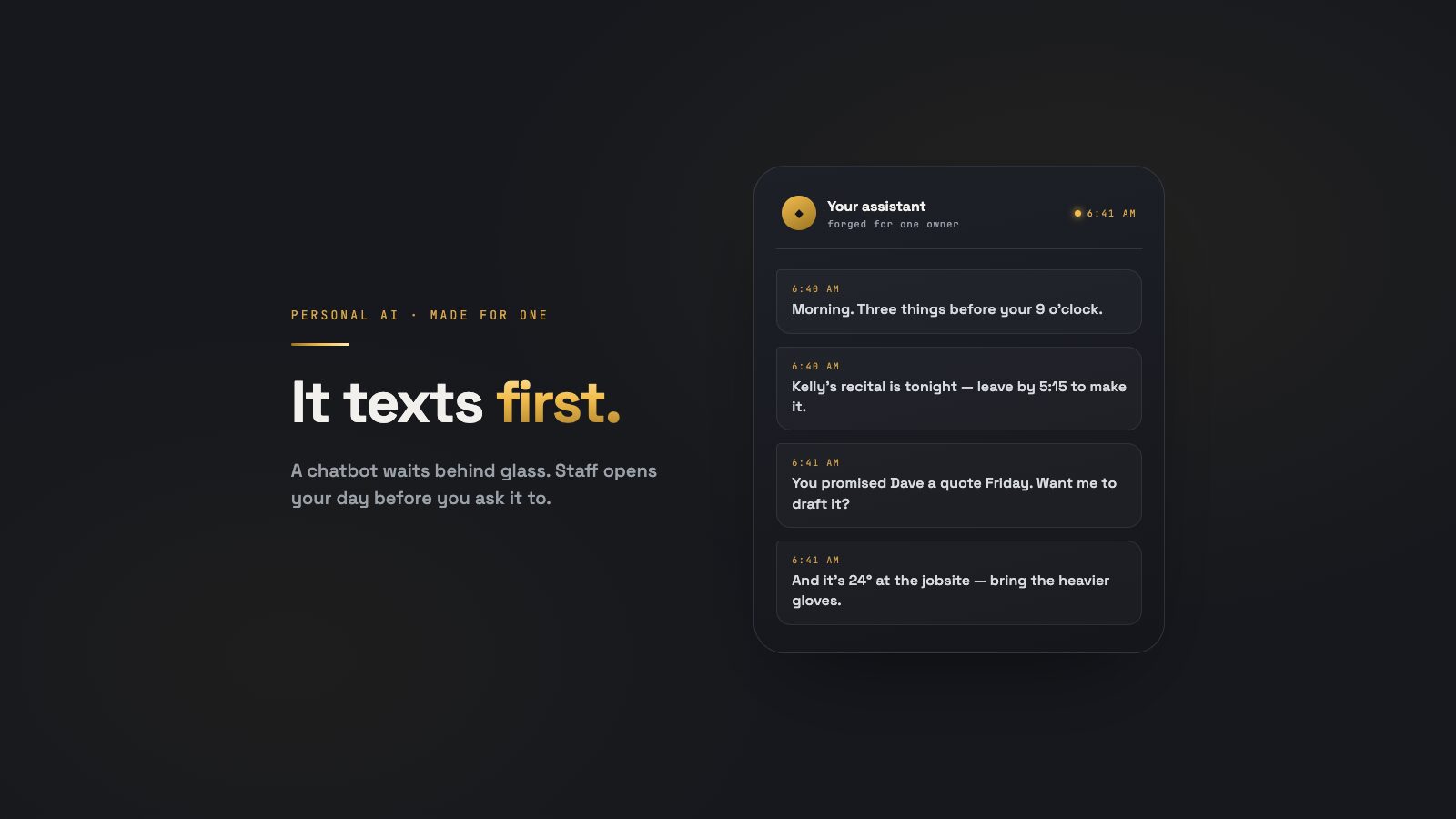
The line between an assistant and a chatbot is who starts the conversation. A chatbot never does. It waits. Staff opens your day with a brief: what's on the calendar, what you promised and to whom, the one email that actually needs you before noon, the weather at the jobsite. It pings you at 5:15 because the recital is at 6 and the drive is 40 minutes. It's the voice that says heads up before the thing goes sideways, not the search box you remember to open after it already did.
The test of an assistant isn't the answer it gives when you ask. It's the thing it tells you before you thought to ask it.
What it runs: work, family, health, your world
We build the assistant around four parts of a life, because that's where the day actually happens.
- Work: your calendar, prep notes before a meeting, reminders that survive a chaotic day, and a running tally of what you promised whom, so nothing quietly slips through.
- Family: birthdays and anniversaries with enough lead time to do something about them, school events, the nudge to leave by 5:15 so you make the recital.
- Health and wellness: workout and meal reminders, appointment tracking, gentle accountability. That's the coaching DNA from our sister fitness company, kept non-clinical and clearly labeled as not medical advice.
- Your world: a morning brief tuned to what you actually care about: your industry, your teams, your markets, your town. Read to you like a sharp aide would, not dumped in a feed to scroll.
How we build one: the Forge Soul
You don't configure a personality from a settings screen. We forge one. The process has three steps and a name we use in-house: the Forge Soul.
- The interview. About an hour, in person or on a call: the people in your life, the dates that matter, how your work runs, your health goals, the news you actually want, your humor, your pet peeves, and the one thing it should never do. Bring a partner or family: they'll remember things you won't think to mention.
- The forging. Over the next couple of days we write the assistant's actual character (how it talks, when it pushes back, when it stays quiet) and seed its memory with everything from the interview. You pick its name. That part tends to sell itself.
- The calibration week. The first week is tuning: too chatty, too formal, more sports and less politics, brief me at six not seven. By the end the personality is locked, and it fits you instead of a template.
After that it's live, and the memory only compounds. Month six knows things month one couldn't.
Why ours don't lie: the discipline layer
We've run our own company on assistants like this for months (three of them, with names and personalities, handling real operations every day). Everything that ever broke taught us a rule, and every rule ships inside the assistants we build. This is the part a weekend tutorial can't copy, because it was paid for in real mistakes.
- It verifies before it claims. It doesn't tell you a thing is done, booked, or sent until it has checked that it actually happened. An assistant that confidently lies to you once is finished.
- It drafts; you send. By default it prepares the email, the text, the reply, and stops. Nothing goes out under your name until you approve it. Reading is scoped, drafting is aggressive because a bad draft costs nothing, and sending always has a human on it.
- It answers from the record, not a hunch. Ask whether it already told you something and it checks its own logs instead of inventing an answer. No record means it says no record.
- It watches itself. Heartbeats, restarts, and rescue paths, so you never discover days later that your assistant has been quietly down.
Your memories are yours
Personal means intimate, so the privacy has to be real, not a paragraph on a policy page. Every assistant runs as its own isolated instance: your memory is never pooled with anyone else's. That memory is a set of plain, readable files you can inspect and export whenever you want; if you ever leave, you leave with them. Your data is not used to train anyone's model. And the assistant holds no medical, legal, or financial advice posture: it tracks and reminds, it doesn't diagnose or advise.
Who it's not for
This isn't for everyone, and it's expensive to pretend otherwise. If what you want is a research tool you open when you have a question, a general chatbot already does that well and costs a fraction of this. If you're not going to let it into your calendar and your day, most of the value never shows up: the magic is in the proactive part, and proactive needs access. And if you want something that acts entirely on its own, firing off emails and booking appointments with no human in the loop, that's the opposite of how we build. Ours prepare and wait for you, on purpose.
The founding cohort
The service is new, so we're keeping the first group deliberately small (a founding cohort capped at ten) until the process is boringly repeatable and every assistant in it is genuinely good. Companion is $990 a month. Executive is $1,990, and adds the calendar, email, family, and health modules plus the proactive mode most people actually come for. Concierge is $3,990 and up: a voice line, custom integrations, a dedicated instance. The Forge Soul setup normally runs $499 to $999 for the interview and the build; for founding clients it's waived. Month to month, cancel anytime.
If that sounds less like a chatbot and more like the assistant you always wanted, that's the point. See how the whole thing works, then tell us about your days; we'll say honestly whether we can forge you one worth keeping.