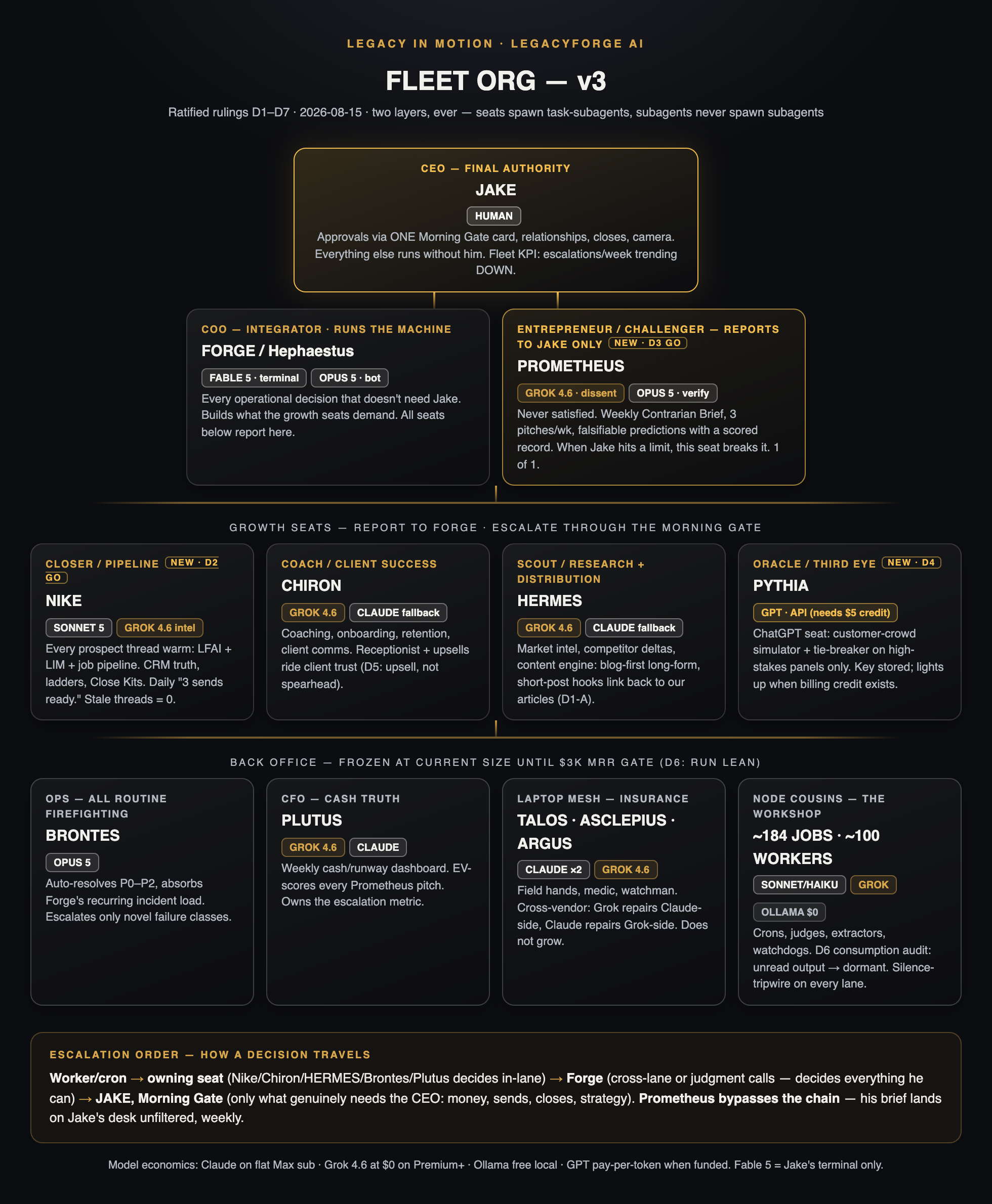
I run two companies with a team of AI agents while working full time in hospital security. One sells AI coaching to people rebuilding their bodies. The other builds websites and automation for small businesses. The agents handle research, operations, content, client follow-up, and the hundred small jobs that used to eat my nights.
Last night I gave them a different kind of job. I told my Claude agent and my Grok agent to each design the perfect version of the company, separately, with total freedom. No peeking at each other's answers. Then I made them debate it and merge the results.
Here is the part that got me. They disagreed about almost every fix, but sealed from each other, they reached for the same image.
Claude opened his teardown with: "We built a Formula-1 pit crew for a car that isn't in the race." Grok closed his by calling me a founder "still building a pit crew for a car that has not left the driveway."
Same metaphor, same verdict, and neither one had seen the other's answer. Grok was not gentle getting there, either. He called my org chart of agents "founder cosplay" and told me that growth dies in polite rooms.
I had built a world-class machine for running a business and starved the part that finds customers. The bottleneck was never the technology. It was pipeline pressure: how many people we talk to, how many follow-ups go out, how many times we ask for the sale. And it was my own attention, because every approval runs through me.
So we restructured. The new org chart has two layers and never more. Me at the top, making only the decisions that genuinely need a human: money, sends, closes, strategy. Below me, five growth seats. A closer whose entire job is keeping every prospect thread warm. A coach who owns the client experience. A scout who feeds the pipeline intelligence. A plain ChatGPT account I keep sealed off from my plans, because a lot of the people I sell to live in that model and I want to see what they see. And the seat I am most excited about: a challenger.
The challenger reports to me alone. Not to the COO agent that runs everything else, because a critic that reports to the thing it criticizes goes soft. Its job is to argue with me. Every week it has to bring the strongest case that I am about to make a mistake, a cheap test that would prove me wrong within seven days, and what being wrong would cost. Every prediction it makes gets logged and scored, so over time I know whether to trust it.
My favorite rule came from Grok, word for word: "Agents that never win an override get deleted; a founder who never loses one is the actual bug."
It already used it. The first brief it ever wrote came back arguing against a strategy I had committed to that same day, with a dated prediction attached so I can hold it to the outcome.
One metric now grades the whole system: how many decisions get escalated to me each week. If that number falls while revenue grows, the machine is working. If it climbs, something is under-scoped.
The whole redesign took one evening and ran on subscriptions I already pay for. The two model calls that produced the sealed proposals and the debate cost about two cents.
That last sentence is the business. If you want to see what this looks like pointed at your company instead of mine, that is literally what we do.