A customer calls your shop at 6:40 on a Tuesday. You're with someone else, or driving, or it's after close. Nobody picks up. They don't leave a voicemail: almost nobody does anymore. They tap the next result and book with whoever answers. You never find out the call happened. An AI receptionist is the thing that answers that call instead. Before you shop for one, it helps to know what the different pricing models are actually charging you for, because the sticker price and the real monthly bill are usually two different numbers.
What an AI receptionist actually does
The good ones do four things and stop there. They answer: first ring, 2 p.m. or 2 a.m., no hold music. They qualify: sort a real job from a robocall, a supplier, or a wrong number. They collect: name, callback number, address, and a plain description of the problem. And they take a booking request (the caller's preferred window) which you confirm before it's real. That last part matters. A receptionist worth paying for does not invent a Tuesday 2 p.m. slot it has no authority to promise. It hands you a clean lead by text or email while the person is still thinking about the problem, and you set the actual time. The AI is the intake. You're still the one who owns the quote and the schedule.
The three shapes the market sells
When you start pricing this out, almost everything falls into one of three billing models. Each has a fair use and a trap. Per-minute bots come first. You pay for talk time, a rate per minute of conversation. It looks cheap on the page. The catch is that you now pay more the longer a customer talks, which is backwards: a chatty, high-intent caller who's ready to book is exactly the one who costs you the most. A busy stretch or a run of long calls, and the bill drifts somewhere you didn't budget.
Per-seat platforms are the second shape. They're built for offices: you pay per user or per agent seat, per month, often with a charge per phone number on top. Fine if you're a ten-desk operation. For a one-truck plumber or a two-chair salon, you're renting a call-center platform to field a handful of calls a day and paying for eight empty seats you'll never sit in.
The third shape is agency-built custom. A firm builds you a bespoke voice agent and bills a setup project plus a monthly retainer. You can get something genuinely tailored this way. You can also get a long discovery process, a big upfront invoice, and a standing dependency on one shop every time you want to change a line of the greeting.
The costs that aren't on the pricing page
The advertised number is rarely the number you pay. The gap is the stuff that doesn't fit on the headline:
- Setup and onboarding fees: a one-time charge to configure the thing, sometimes larger than a few months of the service itself.
- Per-minute overages: the plan "includes" a bucket of minutes, then bills a higher rate once you cross it. Your best months cost the most.
- Integration fees: wiring it to your calendar, your CRM, or your existing phone number is often a paid add-on or a whole tier up.
- Number and messaging fees: a monthly charge per phone line, plus texting fees when it forwards leads to you.
- Annual lock-in: the good monthly rate is frequently the annual-contract rate. Month to month costs more, if it's offered at all.
None of these are scams. They're just the parts that live below the fold. The honest way to compare two quotes is to add up the real total for a realistic busy month, not a quiet one, and see which number you'd actually be signing for.
One rule of thumb: when you see a per-minute rate, multiply it by your loudest month, not your quietest. The month you get the most calls is the month a meter charges you the most, right when you're already slammed.
How we price it
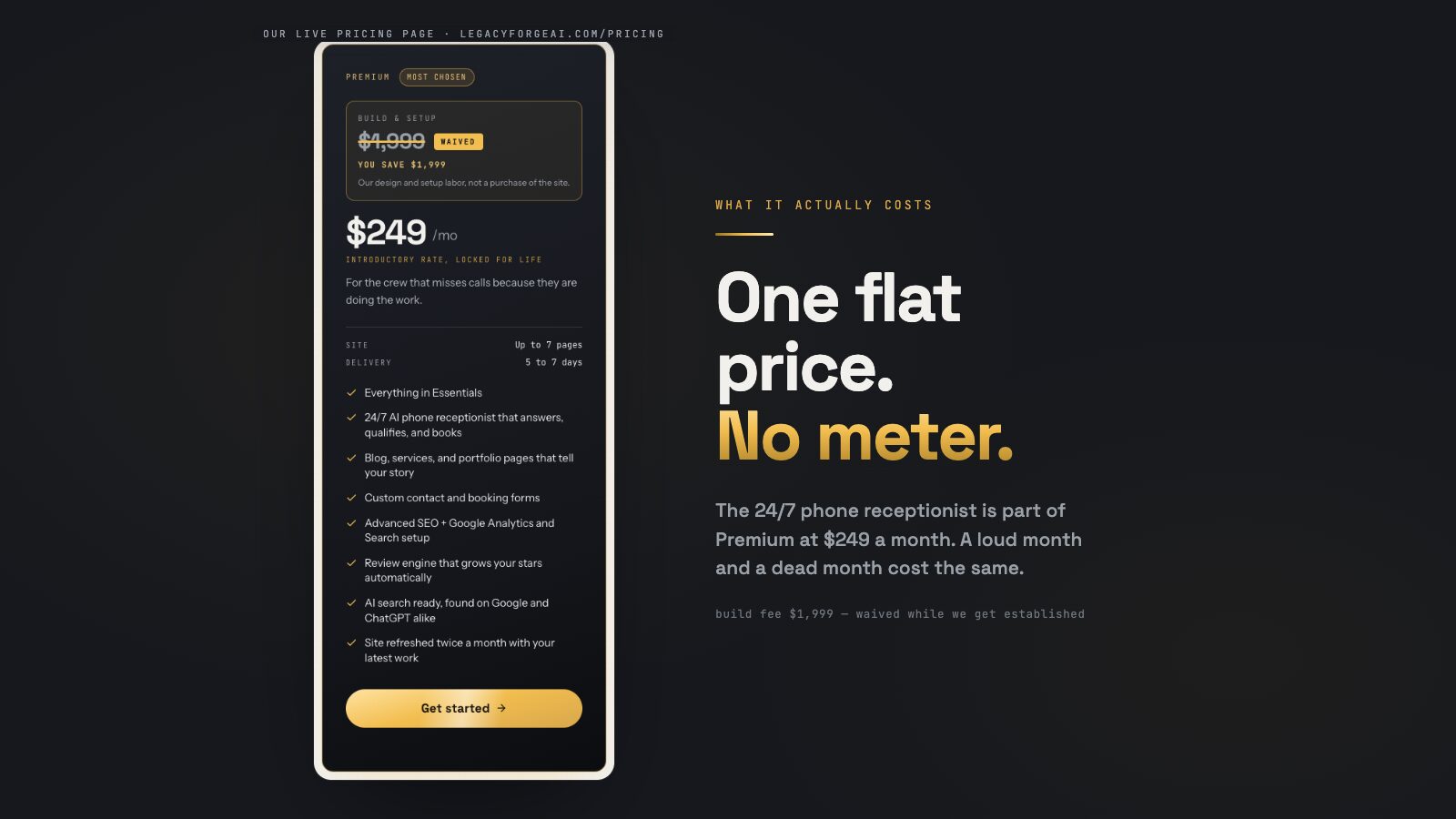
We put the receptionist on a flat monthly plan and throw the meter out. The 24/7 phone receptionist is included with Premium at $249 a month and Enterprise at $399+ a month, and sold standalone at $249 a month for shops that do not have a website with us. That covers the phone line and the web chat intake on your site (the same system answering both) with no per-minute charge. A loud month and a dead month cost the same. The web chat intake on its own starts a tier down, on Essentials at $149 a month; Premium, at $249 a month, is the website with the phone line included. On Enterprise or the standalone line, leads route straight to your phone in real time, and a human confirms the appointment before anyone's counting on it.
The one-time build fees that normally run $1,499 to $2,499+ are waived right now while we get established. It's month to month, cancel anytime, no contract. We're based in Sioux Falls, but the line works the same in any area code: the receptionist doesn't care what state your shop is in, and neither do we.
Who it's not for
This isn't the right tool for every business, and pretending otherwise would just waste your $249. If you already have a front desk that answers every call during the hours that matter, an AI receptionist is a backup you may not need: buy it for the after-hours and overflow gap, not to replace a person who's doing the job fine. If your calls are mostly long, quote-heavy negotiations where the price is the whole conversation, the AI can capture the lead but it can't close it; it's built to take notes and hand off, not to sell. And if you want it to lock firm appointment times with no human confirming, that's not what we ship, on purpose. Over-promising AI creates cleanup work and burns the exact trust you're paying it to protect.
Here's the part you can't fake. Call (605) 315-3900 right now. Our own front desk answers. That is the system we install on your number. Ask it something. Give it a made-up job. Hang up whenever you want. That's the only claim on this whole page you can't check in thirty seconds. If the voice and the handoff feel right for your business, we point the same system at your number and fold it into the plan. If they don't, you've spent thirty seconds and a phone call. Everything else here is just math you can run against your own missed calls.